NFT Financial Layer
A collectible is a bad collateral asset for exactly one reason: nobody can agree what it is worth. That is a market-structure problem, not a taste problem.
The problem
Non-fungible assets broke every financial primitive they touched. Lending markets need a price; a floor price is not a price, it is the lowest ask on a thin book. Automated market makers need fungibility. Liquidation needs a buyer who will show up within the liquidation window, which for most collections is nobody.
The industry’s response was largely to pretend the problem away with floor-price oracles, which worked until the first coordinated floor sweep.
Pooled pricing
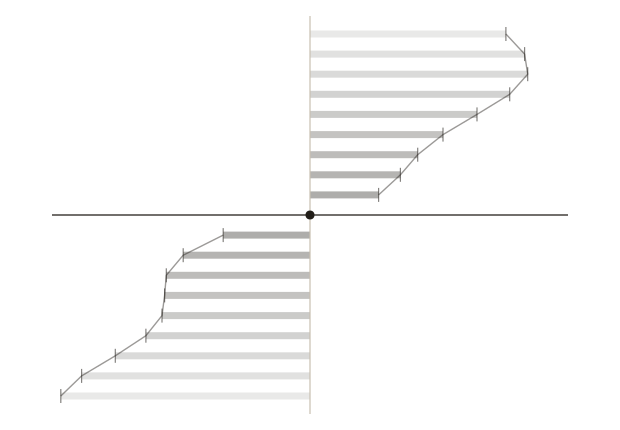
We treat a collection as a distribution rather than a number. Trait-conditioned pricing produces a per-item estimate with an explicit confidence interval, and every downstream primitive consumes the interval rather than the point estimate. A lending market sizes its loan against the lower bound; a structured product prices the spread.
Confidence, not price, turns out to be the number that matters. An item with a wide interval is not un-collateralisable — it is collateralisable at a haircut that reflects what is actually unknown.
Tranching
Above the pricing layer sits a tranching mechanism that separates senior claims on a pool from the junior claims that absorb valuation error first. This is old machinery from structured credit, and it works here for the same reason it worked there: it lets participants with different tolerance for uncertainty hold different parts of the same risk.
Settlement
The layer settles into the same primitives as the rest of the lab’s work, which means an NFT position can be margined, hedged or used as collateral without leaving the system. This is what makes it a financial layer rather than a lending protocol.