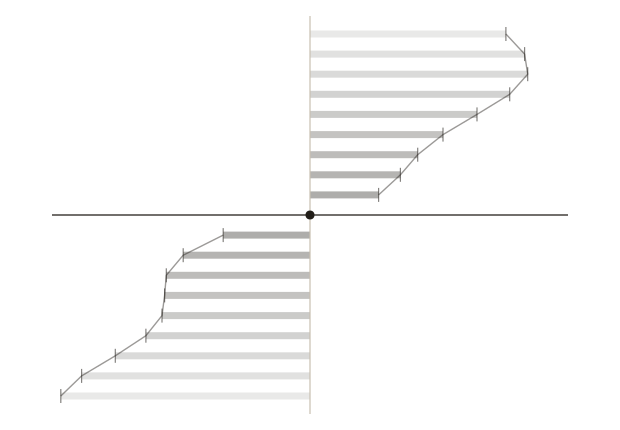
Interfaces for autonomous capital agents
The interface problem for autonomous agents is not a dashboard problem. An agent operating continuously across venues generates more decisions than an operator can read, and a feed of them is not oversight — it is the appearance of oversight, which is worse than none.
We have settled on a principle: the interface should surface the boundary, not the behaviour. An operator does not need to see every position an agent takes. They need to see the mandate the agent is operating under, how close it is to each constraint, and what would happen at the edge. Proximity to a limit is legible at a glance in a way that a stream of fills never will be.
This reframes the primary view from activity to headroom. The screen answers: how much room does this agent have left, in which direction is it consuming that room, and what settles if it runs out. Individual actions remain available, but they are an audit trail rather than a monitor.
The second principle came out of watching people use the first one. Anything an operator might need to do in a hurry has to be reachable without reading. The intervention controls — pause, reduce mandate, force-close — are the only elements on the page allowed to be visually loud, and they do not move between views.
There is an unresolved tension here. Surfacing only the boundary means an operator can be fully informed about constraints while remaining ignorant of strategy, which is adequate for risk and inadequate for judgement. We do not think a screen solves that.